Author’s statement: This page presents the female passenger’s firsthand account, questions, and characterization of the case. The site’s evidence pages separately organize the reports, recordings, correspondence, and unresolved issues.
Chief Deputy Jim and Sheriff Maiorano,
I want a straightforward answer to a straightforward question:
What did I do, as the victim, to be treated this way by your agency from the very beginning?
I never intended to be in Gallup or on that bus. A 15-hour delay changed my route and put me there. I had no control over being assaulted; I did have control over what I did afterward, and I did everything your agency could reasonably have asked of a victim.
Before I ever reached Gallup, I had already faced what I believed would be the most frightening moment of the trip: administering Narcan to another female passenger in Albuquerque. I did not second-guess myself, and no one was standing over me telling me what to do. I knew I had to make the right choice, and I chose to act.
When the man touched me, I did not retaliate physically. I loudly called for help from other passengers. I photographed him. When the bus stopped and it was safe, I immediately reported what happened to the driver.
I did not merely describe the conduct. Immediately after it happened, I physically demonstrated what he had done to me multiple times in front of other people.
I told law enforcement what happened, confirmed that I wanted to prosecute, and provided accurate contact information so I could receive updates.
I have spent weeks trying to understand the decisions that followed.
The accused repeatedly indicated that he had difficulty communicating in English. He requested a translator multiple times and stated that he spoke only “a little bit” of English. Deputy Bittony personally encountered basic comprehension problems while questioning him.
Yet Bittony repeatedly reduced my allegation to generic “touching,” despite already having information concerning repeated contact, my physical demonstrations, and contact involving my buttocks/private area.
The body-camera recording contains six generic “touch/touching” formulations, ten alternative or potentially exculpatory explanations introduced during the questioning, and nine separate reassuring statements directed toward the accused.
Meanwhile, the accused was an international traveler passing through Gallup with no local ties.
The records contain an address missing its apartment number and a disconnected phone number. He omitted the apartment number and gave a disconnected phone number to evade police. There is no indication in the records that either was verified before he was allowed to leave.
The official report then created another set of problems.
Material portions of my account were omitted. Statements favorable to the accused were included. The report left out my explicit statement that it happened four times. It put the private-area description in the driver’s account without preserving it in the summary of my own statement. Even my name was misspelled.
September 18, 2026 update
Now the continued touching is missing from a signed criminal complaint.
At approximately 02:14 on Bittony’s bodycam, I said “Four times” and indicated four with my fingers. I also physically demonstrated the contact and its progression toward my private area in that recorded exchange. I told him. I showed him. The recording preserves it.
The original report did not preserve that four-contact count or the private-area progression in the summary of my own statement. It did at least say I continued to feel Shubham’s hands and fingers and immediately confronted him. That passage is missing from the criminal complaint Bittony signed and that was filed on September 10.
Original MCSO report · page 2
I made contact with [the female passenger], and stated she got onto the bus from Phoenix, AZ. [The female passenger] stated she sat next to Shubham and was moving around to get comfortable. [The female passenger] stated she suddenly felt her right side buttocks touched but thought nothing of it at first; thinking Shubham was moving to get comfortable. However, she continued to feel Shubham’s hands and fingers where she immediately confronted Shubham. [The female passenger] stated she told Shubham to stop and began to record him with her cell phone. [The female passenger] stated Shubham was saying he was sorry and covered his face. Shubham stated she told the bus driver about the incident and she was told the police will be notified.
Signed criminal complaint · PDF pages 2–3
I made contact with [the female passenger], and stated she got onto the bus from Phoenix, AZ. [The female passenger] stated she sat next to Shubham and was moving around to get comfortable. [The female passenger] stated she suddenly felt her right side buttocks touched but thought nothing of it at first; thinking Shubham was moving to get comfortable. However, she told Shubham to stop and began to record him with her cell phone. [The female passenger] stated Shubham was saying he was sorry and covered his face. Shubham stated she told the bus driver about the incident and she was told the police will be notified.
The female passenger’s name is replaced with bracketed text in this public comparison. Highlighting identifies the passage absent from the complaint. The source wording “Shubham stated she” is retained as written.
The complaint preserves the explanation that I initially thought he was getting comfortable. It omits the words explaining that the contact continued and I immediately confronted him. Why does the account reaching the court contain less of what I reported?
Immediately above Bittony’s signature, the complaint states:
I SWEAR OR AFFIRM UNDER PENALTY OF PERJURY THAT THE FACTS SET FORTH ABOVE ARE TRUE TO THE BEST OF MY INFORMATION AND BELIEF. I UNDERSTAND THAT IT IS A CRIMINAL OFFENSE SUBJECT TO THE PENALTY OF IMPRISONMENT TO MAKE A FALSE STATEMENT IN A CRIMINAL COMPLAINT.
Your deputy signed this. Your office needs to explain the missing words.
Sheriff Maiorano, you called the investigation “sufficient.” Chief Deputy Jim, you are handling the records responses. Who changed this paragraph? Who reviewed the complaint against the report and the recording? What did Bittony check before signing it? Will the prosecutor and court receive an accurate account of the continued contact and what I demonstrated?
For precision: the driver’s private-area wording remains in both documents. The missing words at issue here are the continued-contact and confrontation passage from the summary of my own statement. The documents do not tell me who removed it or why. That is exactly why I am demanding an explanation.
Read the documented comparison and open the source records · Watch the recorded account at 01:28–02:20
There were 37 witnesses available to be asked what they saw or heard. Where is the explanation of what was done to identify and interview them?
The card I was handed on July 16
Deputy Bittony handed me this card on July 16, 2026, the day I was sexually assaulted by Shubham and reported it to law enforcement.
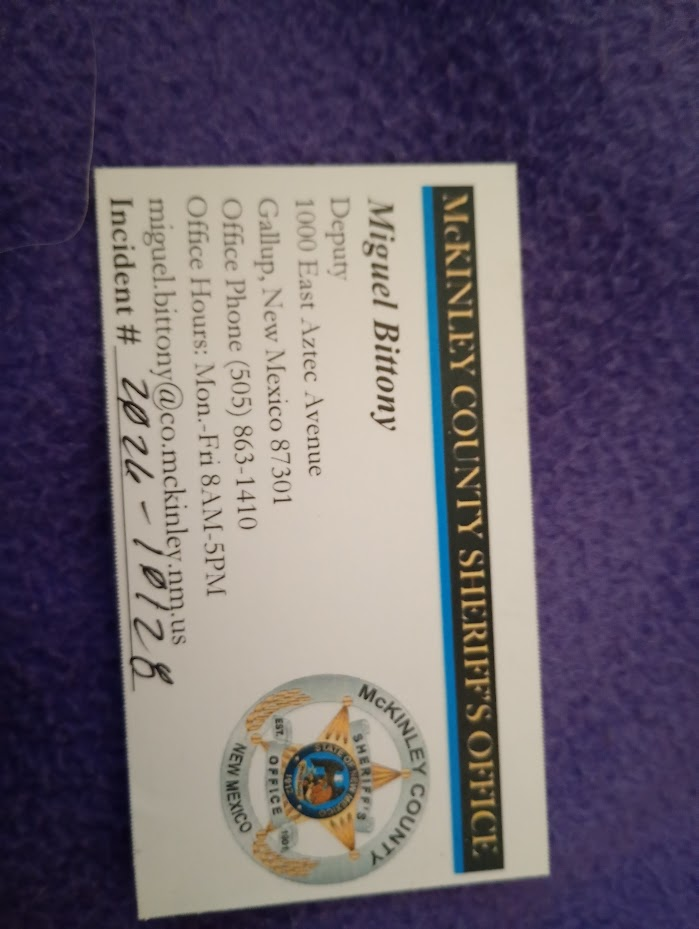
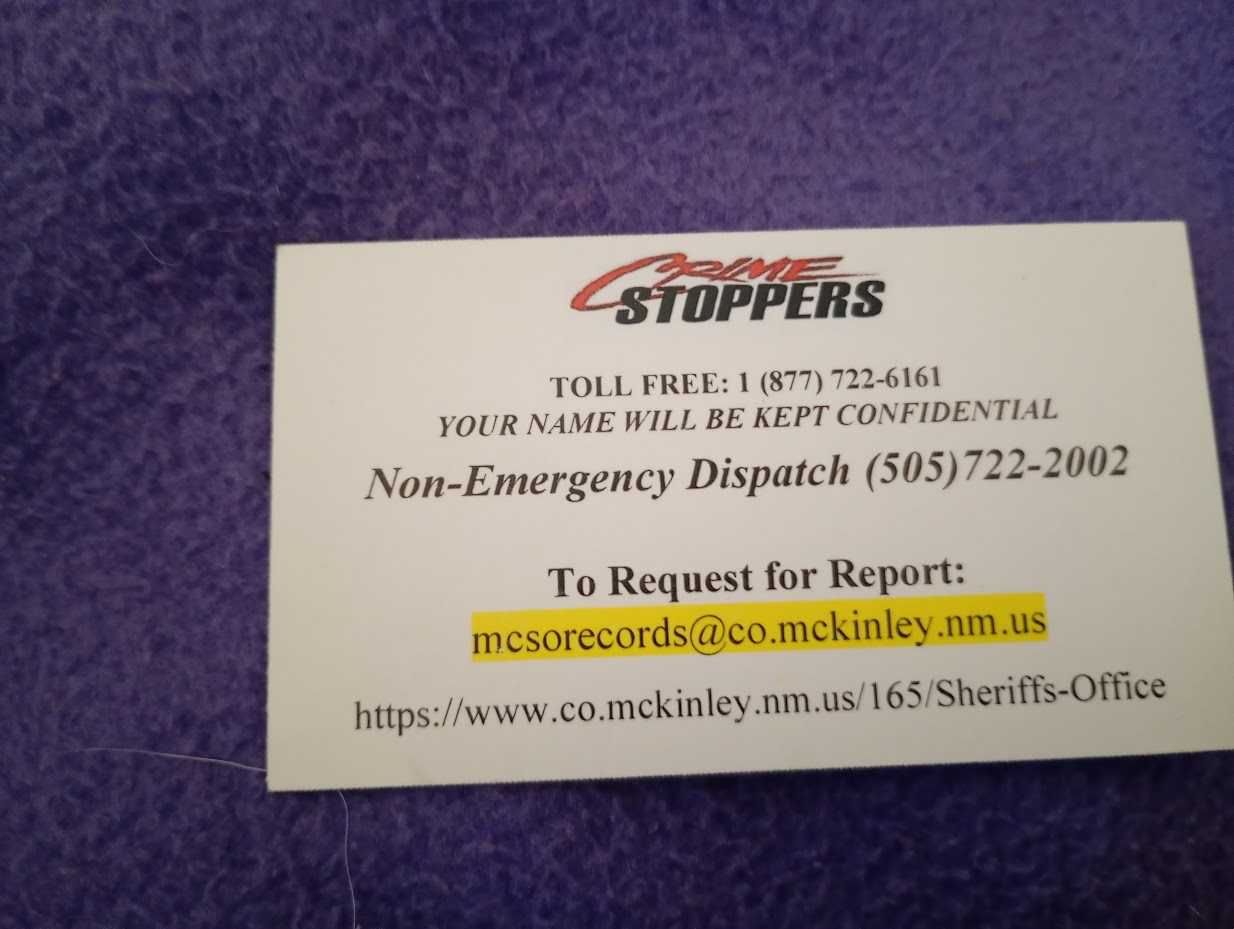
The card gave me an incident number and a way to request records. Neither side gives the accused’s name or instructions for using VINELink.
The lack of basic victim information began on the day of the assault. On July 16, I emailed Deputy Bittony about VINELink:
“How would I use Vinelink for the man who assaulted me, if I don't know his name or information?”
I received no reply to that email. I was asking the deputy who had taken my report that morning how I could get information about the man I had reported.
My separate victim case-status request also went unanswered. I waited for records that already existed and learned that the case had supposedly been sent to the District Attorney only after weeks of uncertainty. I was left to piece together what was happening in my own case.
I then had to discover through records myself that another deputy, Sgt. Savannah Benally, had been present and that she was also the supervisor who reviewed Bittony’s report.
Now there is another fact that makes the handling even harder to understand:
Gallup Police Department has informed me that GPD possessed body-camera footage and on-scene officer notes from the response, but that MCSO did not contact GPD for records concerning this incident and that GPD has no correspondence or records transfer showing those materials were provided to MCSO.
So MCSO declared this investigation sufficient without even obtaining the other responding agency’s body-camera evidence and officer notes.
Then I contacted Sheriff Maiorano.
My August 18 email asked him for a direct command review. I specifically laid out the body-camera evidence, the language-access issues, the generic questioning, the report discrepancies, and the omissions.
On August 21, Sheriff Maiorano responded:
“I reviewed the report and video from Deputy Bittony.”
He then declared the investigation “sufficient.”
I subsequently filed an IPRA request specifically seeking records showing what Sheriff Maiorano actually reviewed before making that determination.
MCSO responded that there were no responsive records identifying the materials reviewed, no responsive access/viewing/audit history, and no responsive records documenting the review itself.
MCSO identified only one responsive email in the separate communications category.
That does not prove that Sheriff Maiorano reviewed nothing.
It does mean MCSO cannot point me to a record showing what his claimed review actually consisted of before he stamped this investigation “sufficient.”
Sheriff Maiorano had my number. I asked him to call. He did not call me.
On August 21, he told me that case questions would need to be handled by a recorded phone call or an in-person visit. Within minutes, I replied: “Call me directly - let's chat, Sir.” I included my phone number.
I waited for a call that never came from him. Four days later, in his August 25 email, he told his department and county officials that I “will not take our calls or call us back.”
I did not refuse to speak with Sheriff Maiorano. I expressly invited him to call me. He needs to explain why he described me to others as refusing the communication I had asked him to make.
I have now requested MCSO’s telephone and voicemail records so that this can be resolved with records rather than competing assertions.
If MCSO actually called me, produce the records.
If MCSO did not, then the statement should be corrected.
Shirley helped arrest another cop. You couldn’t call a victim.
Your Republican opponent, Jeremy S. Shirley, initiated the traffic stop that led to the February 2025 arrest of off-duty State Police officer Rachel Hall, as reported by the Gallup Sun. Gallup officers assisted in that arrest.
Shirley was brave enough to help arrest another cop. You could not even pick up the phone to speak to the girl described on the recording as sleeping with her teddy bear. What, exactly, were you afraid of?
Sheriff Maiorano, you had time to circulate accusations about me to your department and county officials. You never picked up the phone to speak to me. I call that cowardice. You hold the office, command the deputies, and defend their decisions. Have the courage to answer the person who has to live with the consequences.
When I shouted at Shubham, he hid like a scared child. Now, Sheriff Maiorano, I ask you for answers, and you hide behind instructions telling your staff not to respond to me. What is it with the two of you? Neither of y’all can handle a girl who stands up for herself?
You called my requests a “flood.” Here is what they concerned.
In that same August 25 email, Sheriff Maiorano wrote that I was “utilizing AI software attempting to flood the office with IPRA requests.” He sent that characterization to the Sheriff Department distribution address and copied County Manager Anthony Dimas and Deputy County Manager Brian Money. He instructed recipients not to respond to my emails and to forward them to Chief Deputy Jim.
Here are the four MCSO request subjects behind that history:
- July 30: The records from my own case. I had already waited fourteen days, as Deputy Bittony told me to do before contacting the Records Office. I followed his instructions. My original request then covered the reports, responding deputies’ recordings, witness material, and related evidence.
- August 14: Proof of the DA referral. I requested transmission records within the existing email thread after MCSO said the case had been sent and the DA’s office could not locate it. Read the referral chronology.
- August 15: One yes-or-no question about training. Did Deputy Bittony attend the January 19–23 BATI interview and interrogation course? I requested the records needed to establish that answer. On August 21, Eric Jim answered: “Deputy Bittony did not attend the class.” My follow-up that day asked about Benally and command staff’s attendance at the same course. Bittony’s attendance at that particular class is answered; the broader training questions remain.
- August 15: Benally’s bodycam and associated records. I specifically requested Unit 32’s recording after identifying her involvement. Responding-deputy bodycam was already covered by my July 30 request. MCSO did not produce Benally’s July 16 recordings until August 21: 36 days after the incident. Read the request and production history.
Those are four request subjects, including a supplement inside an existing thread. I also sent follow-ups, case-status questions, and a command-review complaint. I am identifying what the records requests sought, not claiming I sent only four emails.
Read selected excerpts from the requests
July 30, original case-records request: “Please provide a complete copy of every record associated with this incident”
August 14, referral supplement: “all records concerning the referral or purported referral of Incident 2026-10128 to the District Attorney’s Office”
August 15, training request: Records showing whether Bittony “registered for, attended, participated in, completed, or received credit for” the specified course.
August 15, Unit 32 supplement: “I am requesting the complete body-worn camera recording from Unit 32”
The reasons matter. I was trying to obtain evidence from my own case, resolve conflicting referral information, and understand the investigation.
I am not a lawyer. I do not have years of training in legal language, public-records procedures, or legal nuance. I used AI to help me understand those issues, organize the records, and explain what I needed from your office. I needed help navigating a process I had never asked to be part of.
I am not a graphic designer or a website developer either. I have had to learn how to organize and present this record while trying to get answers about my own case. Needing help with that work does not make the evidence less real or my questions less valid.
The questions were mine. The case was mine. Using a tool to help me communicate did not make my requests an attempt to overwhelm your office, and it did not make me any less deserving of an answer.
On August 21, you had already written that “we will not continue to converse with you while you are utilizing Artificial Intelligence software.” Four days later, you characterized my records requests as an attempt to flood the office and directed staff not to respond.
Kenneth H. Stalter, co-founder of 505 Legal and the plaintiff’s-attorney representative on the New Mexico Department of Justice’s IPRA Task Force, told me I may use AI to draft IPRA requests. He also previously served as General Counsel to the New Mexico Attorney General. When I explained my use of ChatGPT in a recorded call, he said: “You’re allowed to. You’re allowed to do that!” On September 9, I sent you and county leadership the relevant recording excerpt and call log.
If you were misinformed about using AI to draft IPRA requests, Sheriff, own that too. Correct the restriction you put in writing and the characterization you circulated about me. Your misunderstanding should not become my burden, and your personal opinion of my drafting tool does not justify treating me this way.
Which of those requests should I not have needed to make, and why did asking for answers become a reason to treat me as the problem?
I had already told your office that I was receiving NO case updates. Missing evidence and conflicting answers gave me reasons to follow up. Explain how that history supports the accusation you circulated about my intent.
Would “sufficient” be sufficient for you?
Some of the women involved in handling this case are my age. Had we grown up in the same town, we could have been in the same graduating class at Gallup High. That is how little separates the person behind the desk from the person asking for help.
If one of them had reported what I reported, would she have had to fight this hard to be heard, taken seriously, and kept informed? Would she accept the same unanswered questions about her own case?
I should not have to work for the Sheriff’s Office to receive that same care. Would “sufficient” be sufficient for you?
I am asking you to explain the documented pattern of decisions.
What did I do wrong?
What did I do, from the moment I reported being sexually assaulted aboard that bus, that justified this level of indifference toward me and this level of accommodation toward the accused?
Because from where I am sitting, I did everything a crime victim is told to do.
I reported it.
I preserved evidence.
I identified the accused.
I cooperated.
I asked for prosecution.
I provided accurate contact information.
I followed up.
I asked questions.
I requested the records.
And somehow, at nearly every stage, I have been treated as though I am the problem.
I never asked to be assaulted. I never asked to spend the weeks afterward trying to get answers from a sheriff’s office 1,000 miles from home. I asked that office for help.
I do not want to spend my time chasing records, comparing conflicting answers, and defending myself against the Sheriff’s characterization of me. Every hour spent doing this is taken from my work, my rest, and my recovery. I cannot get that time back. I should not have to keep returning to what happened to me just to make your office answer basic questions about it.
I reported a crime so the people responsible for investigating it could do their jobs. Why am I still carrying the burden of finding the evidence, identifying the discrepancies, and pushing for answers while also having to defend my right to ask?
I deserve peace. I should not have to give up on answers to have it.
What I am asking you to do
- Explain the “sufficient” finding in writing. Identify the evidence reviewed and address the specific omissions and discrepancies raised here, including witness interviews, language access, identifying information, and GPD’s recordings and notes.
- Arrange an independent review. Refer the investigation and the handling of my complaint to a reviewer outside the original investigation and supervisory review. Identify that reviewer, the scope of the review, and how its findings will be communicated.
- Correct documented inaccuracies. Address each disputed report entry and omission, including the continued-contact passage missing from the signed complaint. Identify who prepared, changed, reviewed, and approved that narrative; preserve its drafts and revision history; and explain what correction will be provided to the prosecutor and court. Make the corrections supported by the evidence and explain any refusal. State the factual basis for the accusations that I was attempting to “flood” your office and would not take or return your calls. Withdraw unsupported statements and send the corrections to everyone who received them.
- Name the person responsible for responding. Provide a direct contact and a written timeline for the review, corrections, and a substantive response to these questions. Withdraw the AI-based communication condition and explain how my case questions and complaint will receive substantive answers.
If you decline any of these requests, identify who made that decision and explain the reasons in writing.
I have reported what happened, preserved evidence, cooperated, and identified the questions that remain. I expect you to account for your agency’s decisions with the same care you expected from me.
Put your explanation, your corrective actions, and your response timeline in writing.
The female passenger
Her name and personal contact details are withheld from this public copy.
Have the same questions?
If you have the same questions for MCSO, email Sheriff Maiorano and Chief Deputy Jim directly, or call Chief Deputy Jim:
Sheriff James Maiorano III
James.Maiorano@co.mckinley.nm.us
Chief Deputy Eric D. Jim
Eric.Jim@co.mckinley.nm.us
Cell: (505) 488-8044